Standing at the noticeboard in the main quad, look towards the Radcliffe Observatory (Grade I listed). To the left is the Stephen A Schwarzman Centre for the Humanities, opened at the end of 2025. The development of the Radcliffe Observatory Quarter puts College in a newly strategic position in relation to the University – quite the opposite of how Somerville began.
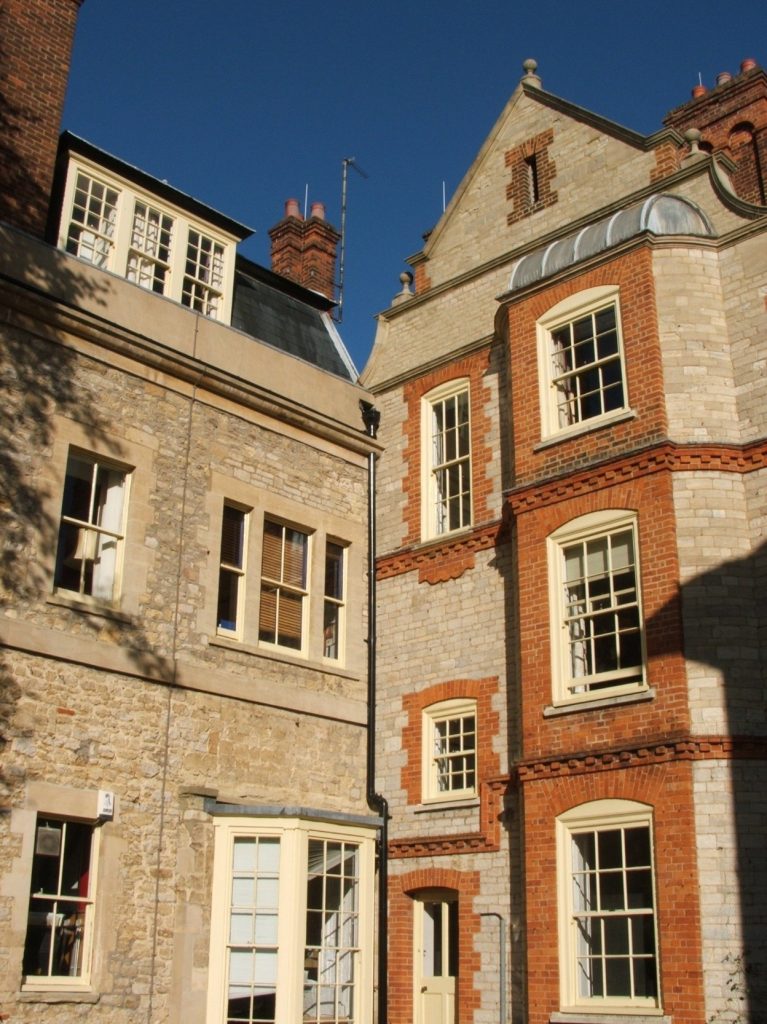
To your immediate right, hidden within ‘House’, you can see the oldest part of college: the walls of Walton House, home to Somerville’s first students (there were only twelve at the beginning). This is the true ‘heart’ of college – where it all began, but also the administrative heart of the institution today.
Looking at the side of House building, compare with this engraving from The Graphic magazine of 1880 below. The image on the bottom right is the view you can still see.

The new women’s hall leased Walton House (built in 1826) from St John’s College, for five years at the outset. Considered to be in the highest and healthiest part of Oxford, it occupied a three-acre site with a kitchen garden and fruit trees, including adjoining cottages which were useful for extra accommodation. It also had a ‘dilapidated coach house and stable’ in the area of the present-day Traffic Quad.
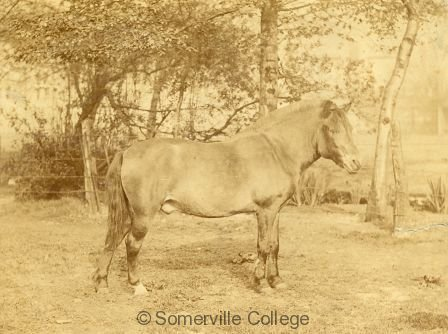
Somerville Hall was established there in 1879 with twelve students, overseen by the first Principal, Miss Madeleine Shaw Lefevre. There were also two cows and a pig– later replaced by a donkey and a pony. As an adjunct to their studies, Miss Shaw Lefevre would teach students to drive the pony (‘Nobby’) and trap.
A shrewd move by the founding committee was to purchase the freehold of the land at an early stage, enabling them to extend their buildings without the negotiations that would have been necessary as leaseholders (LMH was to have difficulties with this).
‘In the Michaelmas term of 1879 when Somerville opened in Walton Manor, the Principal and seven students were accommodated in the House; five students, two servants and a Porteress in the Cottages. … Mrs Vernon Harcourt and Mrs Humphry Ward gave untiring help in all the arrangements and with other friends gave many pictures and gifts to adorn the drawing-room and make it look home-like.’
Vera Farnell, A Somervillian Looks Back, p5,Quoting Miss Shaw Lefevre
A founding principle of Somerville was religious inclusivity (prayers were said daily, but attendance was never compulsory). This was a marked difference in thinking from the Anglican or Church of England group which founded Lady Margaret Hall. The two women’s foundations chose figureheads appropriate to their differing philosophies – in Somerville’s case, a famous woman scientist.
Somerville’s daily life was to be modelled on that of an English family household, where students would live and eat together within one house, rather than having a central dining hall as the existing male colleges did (Maitland Hall was still some time in the future).
As their figurehead the founding group chose Mary Somerville, who had died in 1872. An internationally regarded astronomer, mathematician and geographer, she was one of the greatest women scientists of the age. Married and a mother, she was a supporter of women’s suffrage and of education for women. The Morning Post declared in her obituary that ‘Whatever difficulty we might experience in the middle of the nineteenth century in choosing a king of science, there could be no question whatever as to the queen of science’.
The College arms and motto are those of the Somerville family.
Now enter House…
Continue on the tour